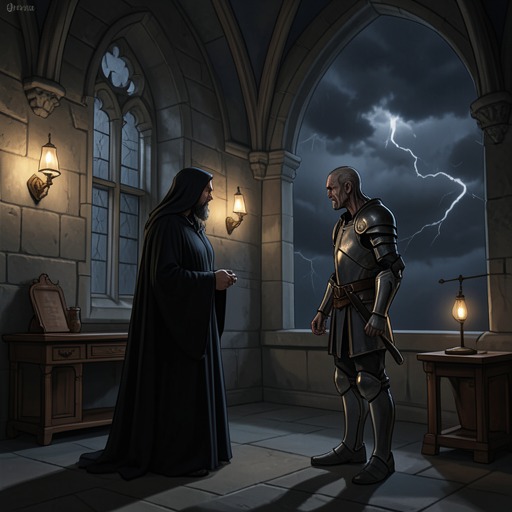
Saint Nicholas
The Castle of OtrantoSaint Nicholas is the supernatural authority who frames Otranto’s hereditary crisis: the saint’s promise to Ricardo appears to sanction his descendants’ rule, but its condition ultimately points beyond them to the rightful heir. In the final vision, Saint Nicholas receives Alfonso’s shade as the revelation of Theodore’s identity resolves the succession dispute.
The Promise to Ricardo
Manfred explains that his grandfather Ricardo poisoned Alfonso and secured Otranto through a fictitious will. During a storm, haunted by guilt and fearing for his life, Ricardo vowed to found a church and two convents if he reached Otranto safely. The sacrifice was accepted, and Saint Nicholas appeared to him in a dream with a conditional promise: Ricardo’s descendants would reign until the rightful owner grew too large to inhabit the castle, provided a male heir of Ricardo’s line remained to possess it.
That promise connects a religious vow to an unlawful transfer of rule. Manfred presents the saint’s assurance not as permanent absolution for Ricardo, but as a bounded period of dynastic power: the family’s rule lasts only while its condition holds. By the time Manfred confesses, he says that no male or female member of Ricardo’s race remains except himself, while the disasters of the preceding three days have exposed the cost of the original usurpation.
The Final Vision
After Matilda’s death, Manfred enters the court and reads the loss in the faces of the company accompanying Hippolita. Thunder shakes the castle, and the walls behind Manfred collapse. Alfonso appears in the ruins, enlarged to immense proportions, and announces that Theodore is Alfonso’s true heir.
The vision then ascends toward heaven. The clouds part to reveal Saint Nicholas, who receives Alfonso’s shade; both figures disappear from mortal sight in a blaze of glory. The assembled witnesses fall prostrate, treating the apparition as a disclosure of divine will rather than a claim that requires further human proof.
Role in the Succession
The two appearances establish different stages of the same supernatural judgment. In Ricardo’s dream, Saint Nicholas defines the temporary terms under which the usurping line may rule. At the close, the saint’s reception of Alfonso’s shade accompanies a direct declaration that the rightful succession belongs to Theodore, making the earlier promise intelligible as conditional rather than final.
Manfred accepts the outcome even though he says he does not know how Theodore can be Alfonso’s heir. He resigns the dominions and turns toward confession, acknowledging that the family’s suffering cannot be separated from Ricardo’s crime or his own rule. Saint Nicholas’s function in the ending is therefore both dynastic and judicial: the supernatural order that once permitted Ricardo’s line to continue now witnesses its displacement and the restoration of the rightful heir.